[ad_1]
It’s a make-or-make league, especially for the Phoenix Mercury.
When they host the Los Angeles Sparks on Friday night (10 p.m. ET, ION), it will be almost a week since the last time the Mercury took the court. Last Saturday, the team had their poorest performance since Brittney Griner returned to the lineup on June 7, falling to the Minnesota Lynx, 73-60. Phoenix did little to compensate for a subpar shooting night—just over 31 percent from the field and around 20 percent from 3—in not only failing to stop Napheesa Collier from submitting another stellar performance, but also by allowing the undersized Lynx to establish an advantage on the glass, preventing the Mercury from turning their many missed shots into second-chance opportunities.
The dynamics of the defeat emphasize the extent to which shooting variance will determine the Mercury’s season-long success. In a WNBA that increasingly has embraced 3-point shooting, this is true of all teams, but particularly so of Phoenix, as they have leaned more heavily into an offensive identity founded on 3-point shooting. Additionally, because the Mercury often are not winning on the margins—forcing turnovers, generating fastbreak points, securing offensive rebounds, etc.—their dependence on strong shooting is heightened.
For instance, the Mercury sit below league average in three of the four Four Factors, the four statistics that capture the four outcomes of an offensive possession as identified by basketball strategist Dean Oliver: effective field goal percentage, free throw attempt rate, turnover percentage and offensive rebounding percentage. Phoenix ranks sixth in the league with an effective field goal percentage of 49 percent. Beyond that, they rank eighth in free throw attempt rate, ninth in turnover percentage and 10th in offensive rebounding percentage. That means the Mercury are not getting to the free throw line enough, turning the ball over too often and coming up short on the offensive glass, a combination that makes it difficult for the team to establish a solid offensive floor. So when the shots aren’t falling, things can go sideways.
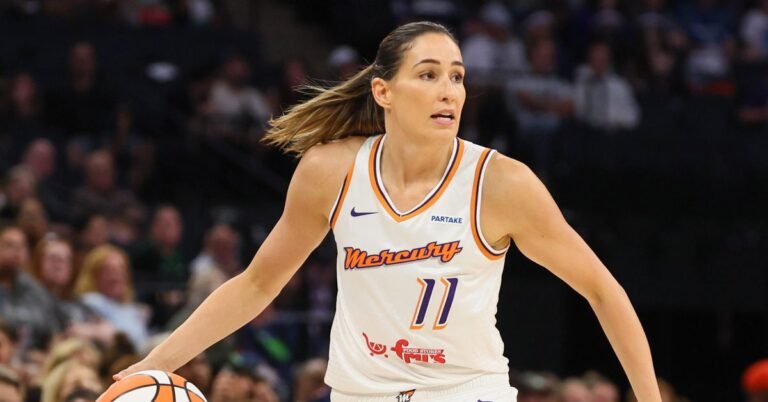
Illustratively, Phoenix has four games where they registered an offensive rating better than the New York Liberty’s league-leading season-long mark of 108.9. Phoenix won three of those games, falling only to the Las Vegas Aces and Jackie Young’s seven 3-pointer and 34-point performance. On June 18, the Mercury and Liberty, the only team that takes more 3s per game than Phoenix, engaged in a high-level shooting affair, with Phoenix shooting 55.1 percent from the field and 50 percent from 3 to edge New York, 99-93. Rebecca Allen led the way with a 5-for-7 effort from deep, while Diana Taurasi finished 4-for-7 from behind the arc.
On the other end of the spectrum, the Mercury have had three games where their offense has been non-existent, exemplified by the historically horrible shooting night they suffered against the Connecticut Sun in late May, which resulted in an anemic offensive rating of 58.8. Last Saturday’s loss to Minnesota was the team second-worst offensive performance of the season, with an offensive rating of 72.3. For the season, Phoenix’s offensive rating is 98.3, good for ninth in the league.
The Mercury’s variance on the offensive end of the floor, combined with their league average defense, suggests the team will continue to experience ups and downs. On nights when the likes of Taurasi, Allen, Kahleah Copper and Sophie Cunningham are draining 3s, Phoenix will look like one of the best team’s in the league, capable of beating any and all comers. Conversely, when the shots aren’t falling, the offense can become aimless, with the team resorting to overly relying on Griner to battle through a crowd for tough buckets.
That should mete out at an overall record around .500 or slightly better, resulting in Phoenix likely maintaining their sixth spot in the overall standings. Because of their boom-or-bust offensive variance, however, the Mercury loom as a dangerous playoff team, especially in a short series. If the 3-point gods smile on Phoenix, they could make quick work of a higher-seeded opponent. That Taurasi and Copper both are proven playoff risers only adds to the Mercury’s status as not only a postseason threat, but also as a darkhorse Finals contender. But if the shotmaking falls short at the wrong time, any postseason hopes quickly could dry up in the Valley.
[ad_2]